

Executive Summary
Deploying Large Language Models (LLMs) into customer-facing support roles presents a major operational risk: hallucinations. When a support bot invents a non-existent refund policy or gives incorrect technical instructions, it destroys customer trust and creates legal liabilities.
Standard out-of-the-box LLM prompts cannot reliably prevent hallucinations. Achieving enterprise-grade accuracy requires a guarded Retrieval-Augmented Generation (RAG) architecture. This playbook outlines the exact system design, vector retrieval strategies, and guardrail logic we use at Isotope Blue to build customer support AI agents with near-zero hallucination rates.
1. The Core Architecture Blueprint
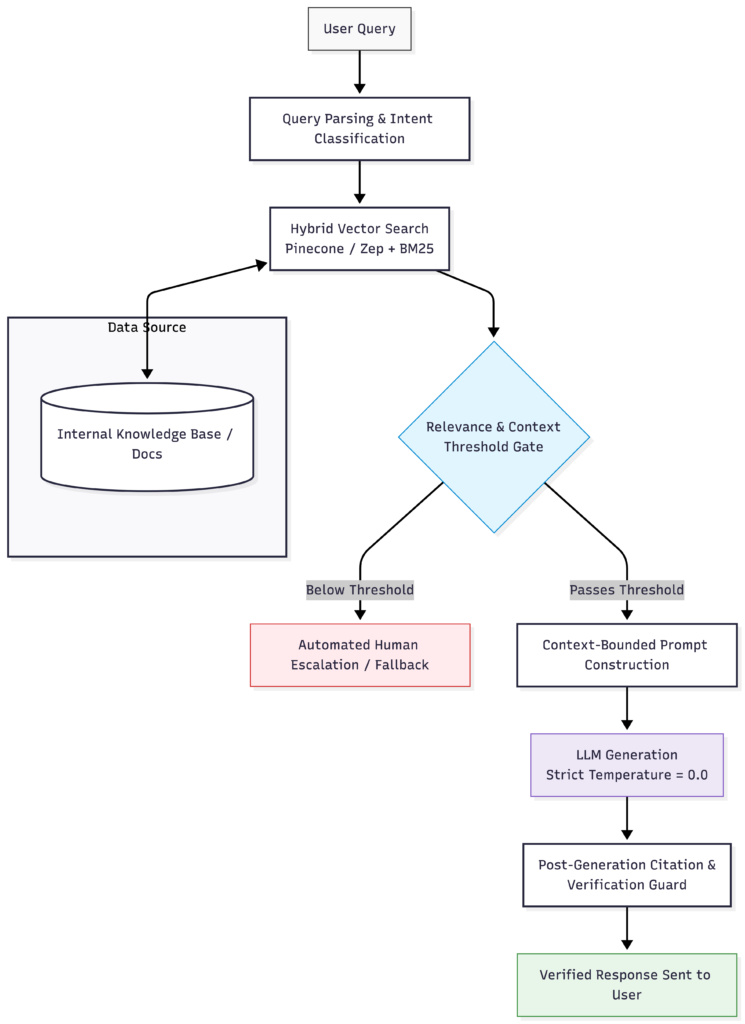
A reliable support RAG pipeline separates knowledge retrieval from language generation. The LLM is never allowed to answer from its pre-trained memory; it acts strictly as a synthesis engine operating on retrieved, verified context.
2. Key Engineering Pillars for Zero Hallucinations
Pillar A: Hybrid Retrieval (Dense Vector + Sparse Keyword Search)
Pure semantic vector search often misses exact technical identifiers, model numbers, or specific error codes. We implement a Hybrid Retrieval Engine:
- Dense Retrieval: Uses vector embeddings (via Pinecone or Zep) to capture conversational intent and conceptual similarity.
- Sparse Retrieval: Uses traditional BM25 keyword matching to ensure exact-match precision for code snippets, SKU numbers, and policy names.
- Reciprocal Rank Fusion (RRF): Merges dense and sparse search results into a single re-ranked context payload before passing it to the prompt.
Pillar B: Rigid Context Boundaries & Fallback Thresholds
The primary cause of hallucination is forcing an LLM to generate an answer when the underlying context does not exist in the knowledge base.
- Relevance Scoring Gate: Every retrieved document chunk receives a cosine similarity/distance score. If no chunk scores above the defined confidence threshold (e.g., $0.82$), the query bypasses generation entirely.
- Deterministic Fallbacks: When context is insufficient, the pipeline executes an automated fallback: “I do not have enough verified information to answer this request accurately. Connecting you to a support specialist…”
Pillar C: Strict System Prompting & Temperature Calibration
We configure the generation layer to act purely as a translator of verified facts:
- Temperature Setting: Forced to $0.0$ to eliminate token randomness and creative drift.
- Strict Negative Constraints: System instructions explicitly forbid assuming external facts or referencing information outside the provided
<context></context>block.
Pillar D: Post-Generation Groundedness Verification
Before the generated response reaches the user, it passes through an automated validation guard:
- Citation Matching: The system checks if every assertion in the output maps back to a specific sentence in the retrieved context block.
- Self-Consistency Verification: A lightweight secondary model evaluates whether the generated output logically contradicts the source document. If a contradiction is detected, the message is intercepted and flagged for human review.
3. Technology Stack Recommendation
| Pipeline Component | Recommended Stack |
| Vector Database | Pinecone (Serverless) or Zep (for dynamic memory + hybrid search) |
| Embedding Models | OpenAI text-embedding-3-large or Cohere Embed v3 |
| Orchestration & Workflow | Python (FastAPI), n8n, or LangChain / LlamaIndex |
| LLM Execution | Claude 3.5 Sonnet / GPT-4o (configured with low temperature) |
| Database Sync | Webhook triggers from Zendesk, Notion, or custom PostgreSQL bases |
4. Key Performance Indicators (KPIs)
When deployed in production, a successful zero-hallucination support engine should deliver the following metrics:
- Hallucination Rate: $< 0.1\%$ across all customer interactions.
- Automated Deflection Rate: $60\% – 80\%$ of tier-1 support tickets resolved without human intervention.
- Sub-Second Latency: Total retrieval and generation pipeline response time under $1.2$ seconds.
- Escalation Precision: $100\%$ accurate routing of unresolved edge cases directly to human support teams with complete conversation transcripts.