
Executive Summary
Deploying LLMs for web chat or text workflows is relatively straightforward. However, bringing real-time, conversational Voice AI into legacy telephony infrastructure—such as traditional PBX systems, SIP trunks, and PSTN lines—introduces a major technical bottleneck: latency.
Human conversation relies on turn-taking pauses between 200ms and 800ms. If an automated voice agent takes 2 to 3 seconds to process speech and generate a response, the user experience collapses.
This playbook details the architectural framework used by Isotope Blue to bridge legacy telephony stacks with modern, sub-second Voice AI pipelines without replacing your core PBX or carrier infrastructure.
1. The Legacy Telephony Bottleneck
Traditional enterprise phone systems (Asterisk, Cisco Unified Communications, Avaya, or cloud PBX setups) rely on standard audio protocols like SIP (Session Initiation Protocol) and RTP media streams using uncompressed or narrowband codecs such as G.711 (µ-law/a-law).
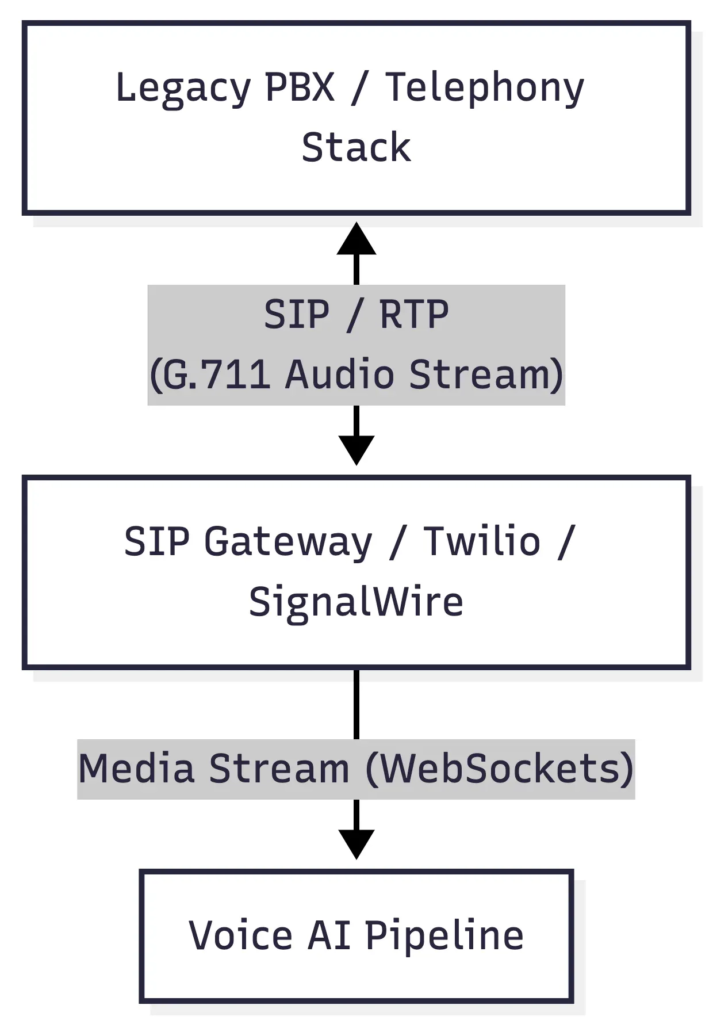
Connecting these systems to AI requires solving three distinct challenges:
- Media Stream Intercept: Converting continuous, bi-directional G.711 RTP audio streams into low-latency WebSocket frames.
- Sequential Pipeline Latency: Managing Speech-to-Text (STT), Large Language Model (LLM) inference, and Text-to-Speech (TTS) generation sequentially.
- Barge-In Handling: Instantly silencing AI audio output when the human user interrupts mid-sentence.
2. High-Level Architecture & Data Flow
To achieve sub-800ms end-to-end response times, we bypass standard batch processing in favor of a streaming microservice pipeline.
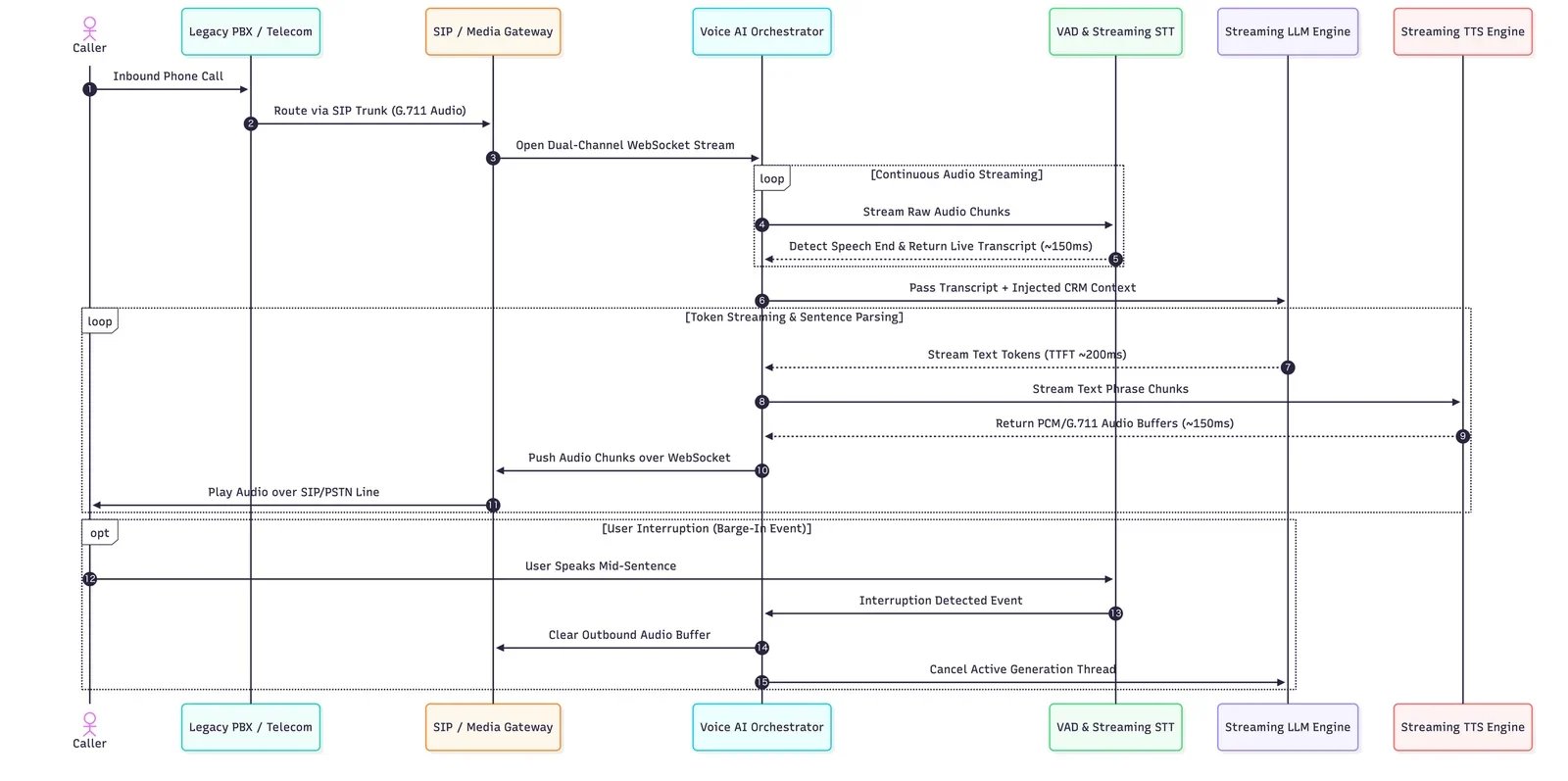
The 5-Step Pipeline Lifecycle:
- SIP Session & Media Gateway: An inbound call hits your legacy PBX, which routes the call via SIP trunking to a media gateway (e.g., Twilio Media Streams, SignalWire, or an internal FreeSWITCH cluster). The audio is piped as a dual-channel 8kHz PCMU/PCMA WebSocket stream.
- Voice Activity Detection (VAD) & Streaming STT: A high-frequency VAD filter identifies human speech boundaries. The raw audio chunk is streamed over WebSockets directly to a low-latency STT engine (such as Deepgram Nova-2 or Whisper Live), returning incremental transcription text within ~150ms.
- Context Injection & Orchestration: The transcribed text is combined with caller context (fetched via API from your CRM or database) and sent to a fast LLM inference endpoint (such as Claude 3.5 Sonnet or Groq-hosted Llama models).
- Streaming Text-to-Speech (TTS): Rather than waiting for the entire LLM response string to finish, tokens are streamed phrase-by-phrase into a TTS generator (e.g., ElevenLabs or Cartesia) to generate audio chunks immediately.
- RTP Audio Packetization: The synthesized audio chunks are re-encoded back into G.711 format and transmitted via WebSockets back to the SIP session.
3. Engineering for Sub-Second Latency
Achieving conversational fluidity requires optimizing every millisecond across the pipeline.
| Pipeline Layer | Traditional Sequential Latency | Optimized Streaming Pipeline | Key Optimization Strategy |
| Audio Transport | 200ms (HTTP Post) | 20ms | Bi-directional WebSockets / gRPC |
| STT Processing | 800ms (Batch) | 120ms – 180ms | Real-time streaming WebSocket STT |
| LLM Inference | 1,500ms (Complete response) | 200ms – 350ms | Time-to-First-Token (TTFT) optimization |
| TTS Generation | 1,200ms (Whole paragraph) | 150ms | First-sentence audio chunk streaming |
| Total Latency | ~3,700ms (Unusable) | ~500ms – 700ms (Conversational) | End-to-End Streaming Architecture |
4. Handling Real-World Edge Cases
A. Implementing Hard Barge-In (User Interruption)
One of the largest friction points in automated phone systems is the inability to interrupt the AI while it is speaking.
- The Fix: The VAD layer runs continuously on the incoming audio track. If the user starts speaking while the AI is outputting audio, the system issues an immediate
clear_audio_buffersignal over the WebSocket. This halts the outbound TTS stream on the SIP gateway within 50ms and cancels the active LLM execution thread.
B. Function Calling & Database Integration
When a caller asks, “Can you check my booking status for tomorrow?”, execution speed is paramount.
- The Fix: We decouple tool calls using asynchronous microservices. The LLM initiates a tool call signal while generating a natural filler phrase (e.g., “Let me look up your account details real quick…”). The database query completes in parallel, feeding updated context back into the LLM stream without stalling the audio.
5. Deployment Framework
At Isotope Blue, we deploy Voice AI layers as Dockerized microservices on high-availability cloud infrastructure (GCP/AWS) alongside your existing telecom setup.
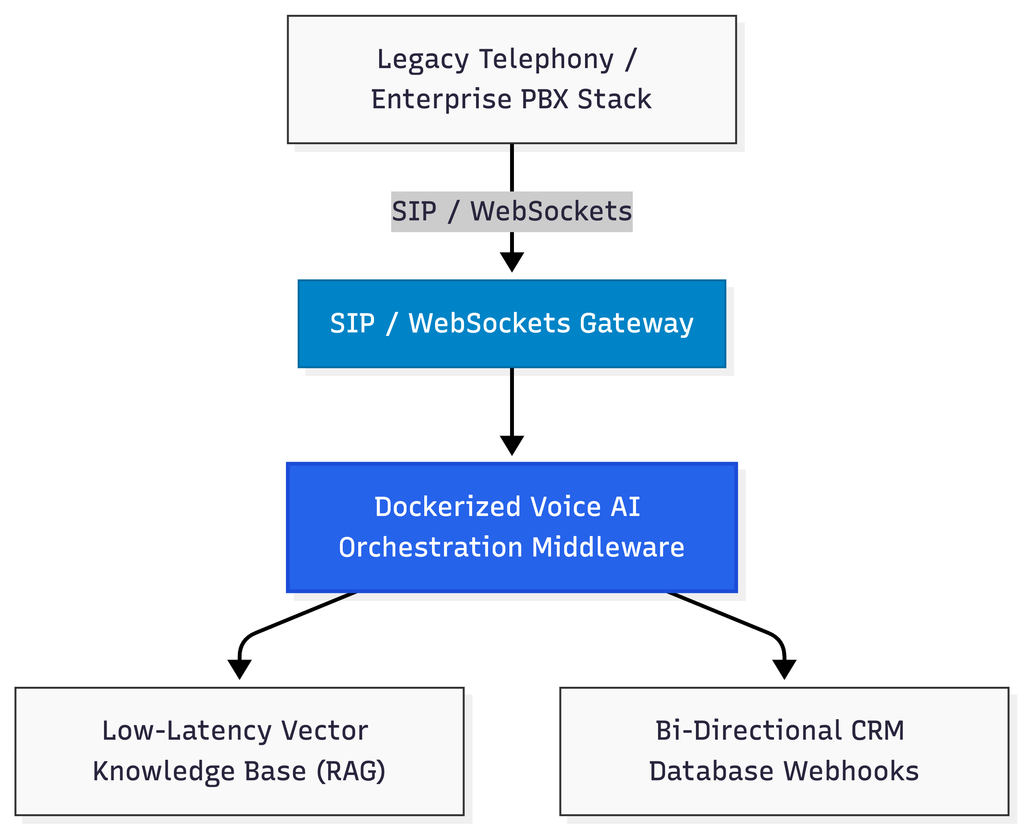
This configuration ensures:
- Zero Infrastructure Overhaul: Keep your existing carrier contracts, phone numbers, and internal PBX routing logic intact.
- Enterprise Security: Audio streams and customer PII are processed through encrypted channels with automated record redaction.
- Scalability: Auto-scaling Docker containers dynamically expand during high-volume call spikes.